As quantum computing moves rapidly from lab experiments to real-world capability, the cryptography that secures our digital world faces its biggest test yet. The encryption algorithms we’ve relied on for decades, such as RSA, ECC, AES, and others, won’t stand up to quantum-powered attacks.
The U.S. National Institute of Standards and Technology (NIST) has already sounded the alarm, releasing the first set of post-quantum cryptography (PQC) standards to help organizations prepare for this large-scale shift. Preparing for PQC isn’t just about future-proofing encryption, it’s about protecting today’s data from tomorrow’s threats. “Harvest now, decrypt later” attacks are already underway, and organizations that delay risk exposing sensitive information, identities, and critical systems.
But here’s the real challenge: most enterprises lack a complete view of their cryptographic assets, spanning certificates, encryption keys, protocols, libraries, and cipher suites across hybrid and multi-cloud environments. Visibility is fragmented, tools are siloed, and manual inventories can’t keep up with the pace of change. Existing solutions often address only parts of the problem, such as certificate expiry, compliance audits, or key management, without providing a holistic view of the overall crypto landscape.
As a result, many organizations are struggling to answer foundational questions such as:
- Which algorithms are in use, and where?
- Which libraries or ciphers are quantum-vulnerable?
- How can we prioritize migration to PQC algorithms across systems?
Quantum resilience starts with crypto awareness. The first step toward a quantum-safe future is gaining full visibility into your cryptographic estate, understanding what’s in use, where it’s used, and how ready it is for what’s coming next. Without this, assessing quantum vulnerabilities or planning a smooth migration to PQC remains nearly impossible.
AppViewX Quantum Trust Hub – Powering Enterprise Readiness for the Post-Quantum Era
The new Quantum Trust Hub helps organizations assess cryptographic vulnerabilities, prioritize remediation, and plan a seamless migration to quantum-safe encryption. It delivers a complete view of every cryptographic asset, from algorithms and third-party libraries embedded in code to crypto libraries, protocols, ciphers, and certificates across configurations and endpoints.
By unifying discovery across source code, runtime environments, and infrastructure layers, Quantum Trust Hub gives teams a complete understanding of where cryptography is used and how each component aligns with post-quantum security standards. This unified visibility and governance help security and compliance leaders take a structured, measurable approach to crypto modernization, making post-quantum readiness a manageable, ongoing process.
Highlights:
- Enterprise Assessment & Remediation:A comprehensive assessment of certificates, algorithms, protocols, libraries, and keys—complete with a Cryptographic Bill of Materials (CBOM) and remediation recommendations.
- Comprehensive Reporting: Detailed reports that assess your crypto-agility across source code, applications, certificates, databases, containers, and more.
- Dashboard Insights: Consolidated view of cryptographic data and insights to support faster, more strategic decision-making.
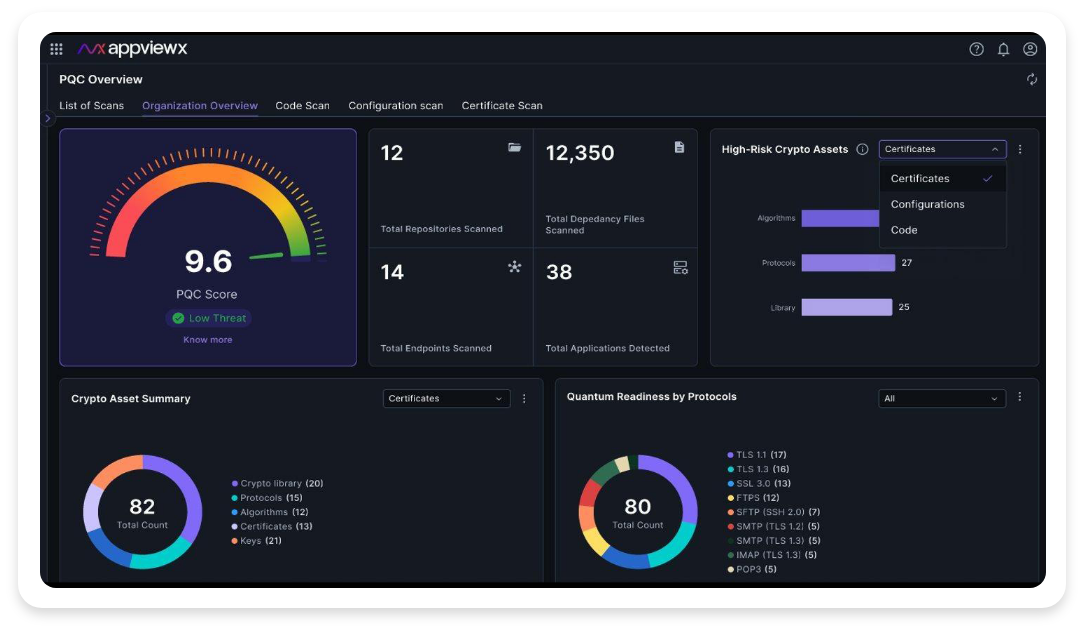 Quantum Trust Hub Dashboard: All CLM customers get visibility into their cert inventory to assess PQC readiness.
The Quantum Trust Hub Advantage
- Get instant insight into your organization’s crypto-readiness with clear visibility into vulnerabilities and guided remediation
- Adapt to new standards published by NIST, NCSC and other regulatory agencies
- Demonstrate security leadership and meet compliance requirements
Core Capabilities of Quantum Trust Hub
Quantum Trust Hub brings together the tools and intelligence enterprises need to operationalize post-quantum readiness. Beyond static audits, it delivers continuous visibility, automated risk assessment, and policy-driven governance across all cryptographic assets.
| Feature | What It Delivers | Why It Matters |
|---|---|---|
| PQC Readiness Scan |
Scans certificates, configuration files, and source code—including third-party libraries—for quantum-vulnerable algorithms. |
Provides total crypto visibility across environments, eliminating hidden risks. Embeds secure-by-design practices in development pipelines and replaces fragmented, manual audits with continuous crypto intelligence. |
| Risk Assessment, PQC Scoring, and Guided Recommendation |
Applies NIST-defined PQC classification to every discovered algorithm, marking them as Resistant or Vulnerable. |
Enables measurable, standards-based risk decisions, helping leadership and DevSecOps teams prioritize remediation and confidently track progress. |
| Adaptive Policy & Governance Framework |
Establishes baseline cryptographic policies aligned with NIST PQC standards. |
Provides context-specific PQC risk ratings and a PQC readiness score that reflect actual business priorities, ensuring remediation efforts focus on what matters most. |
| Dashboard Insights |
Consolidates visibility across certificates, code, and configurations in a single dashboard. Highlights algorithms, key sizes, PQC adoption status, and configuration weaknesses. |
Delivers holistic coverage, prioritizes high-risk assets, and provides enterprise-wide metrics to track PQC readiness. |
Integration, Compatibility, and Deployment Options
The Quantum Trust Hub is built as an integrated module within the AVX ONE CLM platform, leveraging its discovery, automation, and policy control infrastructure. This seamless integration allows organizations to operationalize post-quantum readiness in the same environment they already use for certificate lifecycle management.
Why CLM is the Critical Path to PQC
Quantum migration will require replacing millions of certificates, managing complex dependencies, and maintaining visibility across hybrid environments—all without disrupting operations. A CLM platform makes this achievable by automating certificate lifecycles, continuously discovering cryptographic assets, and enabling seamless issuance and deployment of PQC-ready and hybrid certificates at scale.
To support diverse enterprise architectures, Quantum Trust Hub offers multiple deployment options and integration models.
- Agent-Based for Deep Crypto Discovery
For full visibility across code and endpoints, Quantum Trust Hub uses a secure, lightweight agent integrated directly into DevSecOps pipelines and runtime environments. The agent communicates securely with the management console for unified policy, analytics, and reporting. This provides continuous, real-time visibility without breaking development, helping teams detect and fix cryptographic issues early.
- Agentless for Certificate Discovery
For certificate visibility, Quantum Trust Hub operates agentlessly, using network-level scans and native integrations. It automatically inventories certificates across public and private domains, cloud workloads and managed devices, and certificate authorities.
This enables seamless, zero-footprint discovery—no agents required, no manual tracking—providing complete oversight of certificate validity, issuers, and cryptographic strength.
- Flexible Deployment: On-Prem, SaaS, and Managed Kubernetes (K8s)
Quantum Trust Hub supports multiple deployment models to fit your organization’s security, scalability, and compliance needs.
- On-Prem: For regulated sectors that require full data residency and in-house control.
- SaaS: Cloud-hosted for rapid onboarding, centralized analytics, and minimal maintenance.
- Managed Kubernetes (K8s): Deployed natively on platforms like Amazon EKS, Azure AKS, or Google GKE, for scalable, containerized control in distributed enterprises.
How Can I Get This?
Quantum Trust Hub is available as an add-on module within the AVX ONE CLM platform. Existing customers can start with a free PQC readiness scan to assess their cryptographic posture, or unlock the full-featured module with an additional license.
Reach out to your AppViewX representative to start using the Quantum Trust Hub.
If you are new to AppViewX, contact us to learn how AVX ONE CLM with Quantum Trust Hub can help kickstart your post-quantum readiness journey.
Frequently Asked Questions (FAQs)
-
What types of risks does Quantum Trust Hub detect?
Quantum Trust Hub identifies and categorizes a wide range of cryptographic risks, including:
- Use of weak or deprecated algorithms
- Short key lengths and outdated cipher suites
- Non-compliant or expired certificates
- Quantum-vulnerable assets not aligned with NIST PQC standards
Each finding is assigned a risk score and mapped to recommended mitigations or PQC alternatives
-
How is data handled securely during scans?
All agent communications are encrypted, and data collected during scans remains fully under the organization’s control based on the chosen deployment model. On-prem and managed K8s deployments retain full data residency, while SaaS deployments comply with enterprise-grade security and encryption standards.
-
Who benefits most from Quantum Trust Hub?
CISOs, Security Architects, DevSecOps teams, and Compliance Officers gain unified crypto visibility into their cryptographic landscape and quantum readiness insights. It helps:
- Reduce crypto risk exposure
- Simplify compliance and audit readiness
- Build a roadmap toward post-quantum security
In short, it transforms cryptography from a hidden risk into a managed, measurable asset.
-
Does Quantum Trust Hub require agents to run?
Yes. Quantum Trust Hub uses lightweight, secure agents for deep crypto discovery across code, configurations, and runtime environments. However, certificate discovery is fully agentless, allowing network-level inventory without deploying additional components. This hybrid approach ensures both depth and simplicity of continuous insight with minimal operational overhead.
Ready to take the first step toward quantum readiness?
- Download the Quantum Trust Hub Datasheet
- Visit the PQC Solution Page
Tags
About the Author

Revathi Chandrasekaran
Product Owner, AppViewX
Revathi is a passionate product owner who wants to solve real customer problems with real-world solutions. She enjoys turning ideas into products that deliver clear value. With a mindset rooted in curiosity, collaboration, and continuous improvement, she aims to build products that truly meet customer needs and drive business success.